



Every organization runs fire drills. Most organizations believe their staff is prepared.
Most organizations are wrong.
There’s a gap between knowing what to do in a fire emergency and actually being able to do it — calmly, quickly, correctly — when smoke is filling the room, the alarm is blaring, and the adrenaline has already hit. Traditional fire drills don’t close that gap. They rehearse evacuation. They don’t train response.
VR safety training for fire was built specifically to close that gap.
The Problem With the Way Most Organizations Train for Fire
Walk through what a standard workplace fire drill actually involves. An alarm sounds at a pre-announced time. Everyone stops what they’re doing, files out through designated exits, gathers at the assembly point, a headcount is taken, and people return to their desks within fifteen minutes.
This is useful for exactly one thing: confirming that people know where the exits are.
It does not teach anyone how to identify the class of fire they’re dealing with. It does not teach correct fire extinguisher selection or operation. It does not place anyone in the physiological state — elevated heart rate, narrowed attention, degraded fine motor control — that an actual fire produces. And it does not allow anyone to make mistakes, learn from them, and try again.
The result is a workforce that has technically completed fire safety training, feels reasonably confident about it, and would perform poorly in an actual emergency. This is what safety professionals sometimes call “compliance theater” — training designed to satisfy a regulatory checkbox rather than actually build capability.
VR safety training for fire breaks this pattern entirely.
What Happens Inside a VGLANT Fire Training Session
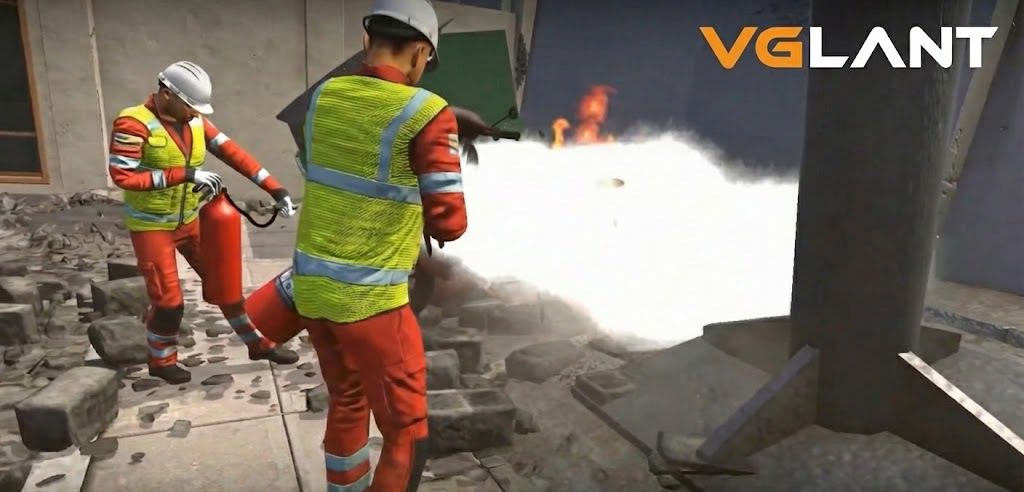
VGLANT’s VR fire training platform, accessible at https://vglant.com/, places trainees directly inside a virtual emergency scenario — not as observers, but as active responders who must assess, decide, and act.
The simulation begins with a realistic environment: a workplace, a facility, a commercial space. A fire starts. The trainee has to read the situation — the size of the fire, the materials involved, the available egress routes — and respond appropriately.
This immediately introduces something traditional training never does: cognitive load under simulated stress. The trainee has to think while feeling the urgency of the situation. The VR environment triggers genuine physiological response — adrenaline rises, attention narrows — because the brain, presented with a realistic emergency scenario in immersive 3D, responds to it as a real threat at a level below conscious reasoning.
The training module covers the fundamentals that actually save lives in fire emergencies. Basic fire knowledge — the fire triangle, how fires propagate, what makes different classes of fire behave differently. Fire extinguisher agents — which type addresses which class of fire, and critically, what happens when you use the wrong one. Extinguishing procedure — the standardized PASS technique, practiced repeatedly until the muscle memory is reliable.
Every session is recorded. Performance metrics — task completion time, correct agent selection, procedure accuracy, decision speed — are captured and fed into an admin dashboard where safety managers can review individual and team readiness at a glance.
Why Immersion Produces What Compliance Doesn’t
The scientific basis for VR safety training for fire is well-established in learning psychology.
Procedural skills — the kind that fire response requires — are encoded most durably through active practice under conditions that approximate the real situation. Reading a procedure manual encodes declarative knowledge: you know the steps. Watching a video encodes observational knowledge: you’ve seen the steps. Neither encodes procedural knowledge — the body-level competence that activates automatically under pressure — the way physical practice does.
VR immersion bridges the gap. Because the simulation is visually and acoustically convincing enough to trigger genuine stress response, the brain encodes the practiced behavior as real experience. The muscle memory that builds during a VGLANT session is meaningfully closer to the muscle memory that real fire response requires than anything a paper drill or a video module produces.
There’s a secondary benefit that safety managers consistently report: engagement. VR training holds attention in a way that PowerPoint presentations categorically do not. Trainees who complete a VGLANT session remember it. They discuss it. They retain the information. This is not a minor advantage — training that isn’t remembered isn’t training.
The Zero-Risk Advantage
There is one more dimension of VR safety training for fire that deserves explicit attention, because it’s easy to overlook.
In real fire response training, there’s an inherent tension between realism and safety. You can use a live flame for familiarization, but you can’t expose trainees to genuine fire conditions without genuine risk. Training fires can and do cause injuries. The conditions that make fire response genuinely difficult — heat, smoke, reduced visibility, extreme noise — cannot be safely replicated at the intensity a real emergency produces.
VR removes this constraint completely. VGLANT’s simulations can reproduce any fire scenario at any intensity, including scenarios that would be impossible or dangerous to replicate in physical training — large-scale industrial fires, enclosed space fires, multi-room residential emergencies. Trainees can make wrong decisions, experience the simulated consequences, and learn from them without any physical risk.
This isn’t just a safety benefit. It’s a training benefit. The ability to fail safely and try again is one of the most powerful mechanisms in skill acquisition, and traditional fire training largely denies it.
Building a Proactive Safety Culture
The shift from reactive to proactive safety culture — from “we train because regulations require it” to “we train because we are genuinely committed to our people being prepared” — requires tools that actually build capability rather than document compliance.
VR safety training for fire is that tool. It takes existing safety documentation and standard operating procedures and converts them into immersive simulations that staff can run repeatedly, track progressively, and actually retain.
The organizations that make this shift don’t just improve their safety metrics. They change the relationship their people have with emergency preparedness — from a box to check to a skill they actually own.
Learn how VGLANT’s VR fire training platform can transform your organization’s safety readiness at https://vglant.com/