

Workplace fire incidents remain a persistent occupational hazard across industrial sectors worldwide. According to the International Labour Organization (ILO), approximately 2.93 million workers die annually from work-related accidents and diseases, with fire-related incidents contributing a significant proportion in manufacturing, mining, and energy sectors. In response, regulatory frameworks such as OSHA 29 CFR 1910.157(g) mandate annual fire extinguisher training for all employees who may be expected to use portable fire suppression equipment.
Conventional fire extinguisher training typically involves classroom instruction followed by live-fire drills using real chemical agents. While this approach satisfies compliance requirements, it carries substantial direct and indirect costs that accumulate over time. The emergence of Virtual Reality (VR) simulation technology has introduced an alternative training methodology that warrants rigorous cost-benefit examination.
This article presents a structured cost-benefit analysis comparing conventional fire extinguisher training with VR-based simulation, drawing on operational data from industrial companies in Southeast Asia, including those within the Virtu industrial network operating across mining, energy, and manufacturing sectors.
Cost Structure of Conventional Fire Extinguisher Training
Direct Material Costs
Every live-fire training session requires the discharge of at least one fire extinguisher per participant group. Dry Chemical Powder (DCP) extinguishers, the most commonly used type in industrial settings, require professional refilling after each discharge. Industry data from Indonesian fire equipment vendors indicates that a single 6 kg DCP refill costs between Rp 150,000 and Rp 350,000, depending on location and service provider. For a facility training 300 employees annually in groups of 10, this translates to 30 discharge-and-refill cycles, yielding a consumable cost of Rp 4.5 million to Rp 10.5 million per year at a single site.
Additionally, many organizations deplete extinguisher units approaching their expiration date for training purposes. While this appears resource-efficient, it creates a gap in the facility’s active fire suppression inventory during the period between training and replacement procurement. This inventory gap represents an unquantified safety liability.
Indirect Costs: Productivity Loss
The most significant cost component in conventional fire training is non-productive time. A standard live-fire drill session, inclusive of employee marshaling, safety briefing, queuing, individual practice, and post-drill cleanup, consumes 90 to 120 minutes per group. Using a conservative estimate of Rp 75,000 per worker-hour for a mid-skill industrial employee, a 2-hour training session for 300 employees generates Rp 45 million in lost productivity annually at a single facility.
For geographically distributed operations — common in the mining sector where companies like those in the Virtu network manage multiple remote concession sites — this figure multiplies proportionally. A company operating five sites with similar workforce sizes faces a cumulative annual productivity loss exceeding Rp 200 million solely from fire training downtime.
Environmental and Regulatory Costs
Post-training environmental remediation is an increasingly relevant cost factor. DCP residue is classified as a mild irritant and requires physical cleanup to prevent soil contamination. In jurisdictions with strict Environmental, Social, and Governance (ESG) compliance requirements, improper disposal of training byproducts can trigger regulatory penalties. Open burning permits for live-fire demonstrations carry additional administrative costs and are subject to seasonal restrictions in many Indonesian provinces.
Cost Structure of VR-Based Fire Extinguisher Training
Capital Expenditure
VR fire training systems require an initial investment in hardware (VR headset, motion controllers, computing unit) and software licensing. Current market pricing for enterprise-grade VR safety training platforms, including those offered by Indonesian providers, ranges from Rp 50 million to Rp 200 million depending on the number of modules, customization requirements, and multi-site licensing terms.
Operating Expenditure
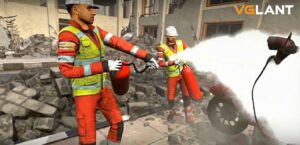
Following initial deployment, the marginal cost per training session in VR approaches zero. There are no consumables to replenish, no chemical agents to discharge, and no environmental cleanup required. The primary recurring costs are limited to hardware maintenance, software updates, and occasional equipment replacement. Platforms such as VGLANT are engineered for industrial durability, with VR training modules that allow unlimited repetitions per session without incremental cost.
Time Efficiency
VR training sessions average 15 to 20 minutes per participant, representing a 75% to 85% reduction in training time compared to conventional methods. The elimination of queuing, marshaling, and cleanup phases accounts for the majority of this time savings. Furthermore, VR systems are portable and can be deployed in existing facility spaces (break rooms, meeting rooms, site offices), removing the need for dedicated outdoor training yards.
Comparative Analysis
| Cost Parameter | Conventional Training | VR-Based Training |
| Consumable cost per cycle | Rp 150K–350K per refill | Rp 0 (digital) |
| Session duration per group | 90–120 minutes | 15–20 minutes per person |
| Annual consumable cost (300 pax) | Rp 4.5M–10.5M | Rp 0 |
| Annual productivity loss (300 pax) | Rp 45M+ | Rp 7.5M–10M |
| Environmental cleanup | Required (DCP residue) | Not applicable |
| Trainer travel (multi-site) | Rp 15M–25M per trip | Rp 0 (standardized module) |
| Training repetition capacity | 1–2 reps per session | Unlimited reps per session |
| Quality consistency (multi-site) | Variable (trainer-dependent) | Standardized (software-controlled) |
Discussion
The data indicates that VR-based fire extinguisher training achieves breakeven within 6 to 18 months of deployment, depending on organizational scale. The primary cost advantage derives not from the elimination of consumables, which is relatively modest in absolute terms, but from the dramatic reduction in non-productive time. For industries with high hourly productivity values — particularly mining operations where output is measured in tons per hour — this time efficiency translates into substantial financial recovery.
It is important to note that VR training is not proposed as a complete replacement for live-fire training. The tactile experience of handling a real extinguisher and the sensory exposure to actual fire and smoke retain pedagogical value. The recommended approach, supported by occupational safety literature, is a hybrid model: annual live-fire demonstrations supplemented by quarterly VR refresher sessions for technique reinforcement and scenario-based decision-making practice.
Conclusion
Virtual Reality fire extinguisher training presents a quantifiable cost advantage over conventional methods in industrial settings, primarily through the reduction of non-productive time, elimination of consumable expenditure, and removal of environmental remediation requirements. For multi-site operations in sectors such as mining and heavy industry, the additional benefit of standardized training quality across geographically dispersed locations further strengthens the financial case.
Organizations evaluating this transition should conduct site-specific cost audits of their current fire training programs, accounting for both visible line items (instructor fees, refill costs) and hidden costs (productivity loss, environmental compliance, trainer travel). The resulting data will inform a more accurate return-on-investment projection than industry averages alone can provide.