


There’s a moment every new heavy equipment operator in mining dreads. It’s not the written exam. It’s not the classroom lecture. It’s the first time they climb into the cab of a haul truck that weighs more than a commercial airplane and realize that starting this machine involves far more than turning a key.
For PT Bukit Makmur Mandiri Utama — better known as BUMA — this moment used to be a bottleneck. As one of Indonesia’s largest mining contractors with over 11,500 employees, 3,500 units of heavy equipment, and operations spanning Kalimantan’s coal-rich corridors, BUMA onboards new operators constantly. Every single one of them needs to go from zero to field-ready on machines that don’t tolerate beginner mistakes. The margin for error when you’re operating a 100-tonne excavator on a steep bench face isn’t slim — it’s nonexistent.
Traditional training tried its best. Classroom sessions covered the theory. Manuals documented the procedures. Experienced operators rode along as mentors. But there was always a gap between understanding how something works on paper and actually feeling it in your hands, in real time, with real consequences.
That gap is where accidents lived. And BUMA decided to close it.
When Manuals Are Not Enough
Mining is not manufacturing. You can’t pause a coal face the way you pause a conveyor belt. You can’t rewind a landslide. You can’t undo a collision between two haul trucks on a narrow pit road. The environment shifts constantly — topography changes with every blast cycle, weather conditions flip within hours, and traffic patterns across the pit evolve shift by shift.
For new operators, this creates an overwhelming cognitive load. They’re simultaneously learning to operate sophisticated machinery, navigate an unfamiliar and hazardous terrain, follow strict safety protocols, communicate with dispatch, and make judgment calls that affect not just their own safety but the safety of everyone around them.
BUMA’s training team recognized a fundamental truth: you cannot prepare someone for this level of complexity by talking about it. They need to experience it. They need repetitions in environments that feel real but carry no real consequences. They need to make mistakes in a space where a wrong decision results in a learning moment rather than an incident report.
That recognition led them to Virtu.
Building a Virtual Mine That Feels Like the Real One
Virtu is an Indonesian immersive technology company that specializes in building VR training simulations from the ground up — not off-the-shelf modules, but custom environments designed around each client’s specific operational reality. Their philosophy is straightforward: if a VR training doesn’t faithfully mirror the actual working conditions, it won’t change behavior. And behavior change is the whole point.
For BUMA, Virtu developed a comprehensive VR training system specifically for heavy-duty mining vehicle operations. The approach was methodical and built in layers, each one adding depth to the trainee’s understanding before they ever touch a real machine.
The first layer is component familiarization. Trainees are placed in front of a full-scale virtual replica of the actual equipment models used across BUMA’s sites. They can walk around the vehicle, examine every external component, understand the function of each part, and see how the mechanical systems connect. This is not a simplified cartoon version of a haul truck. It’s a detailed three-dimensional model that matches the real unit down to the hydraulic lines and tire treads.
The second layer takes trainees underneath and inside the vehicle. They inspect the inner workings — engine compartments, hydraulic systems, drivetrain components — the parts that matter for pre-shift inspections and preventive maintenance. Understanding what’s under the hood is not optional when your daily routine includes checking oil pressure, coolant levels, and brake system integrity before moving a piece of equipment that could flatten a pickup truck.
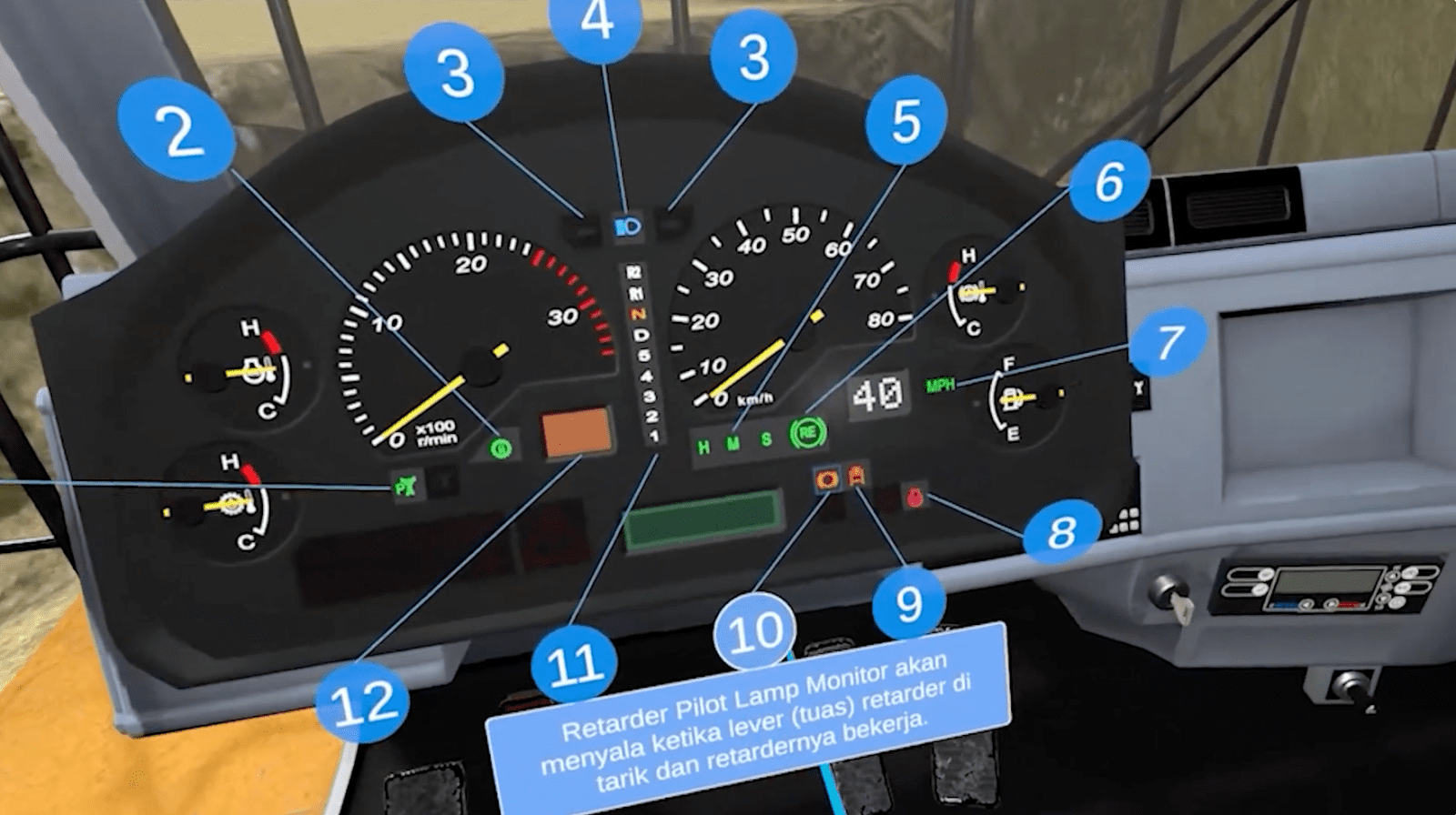
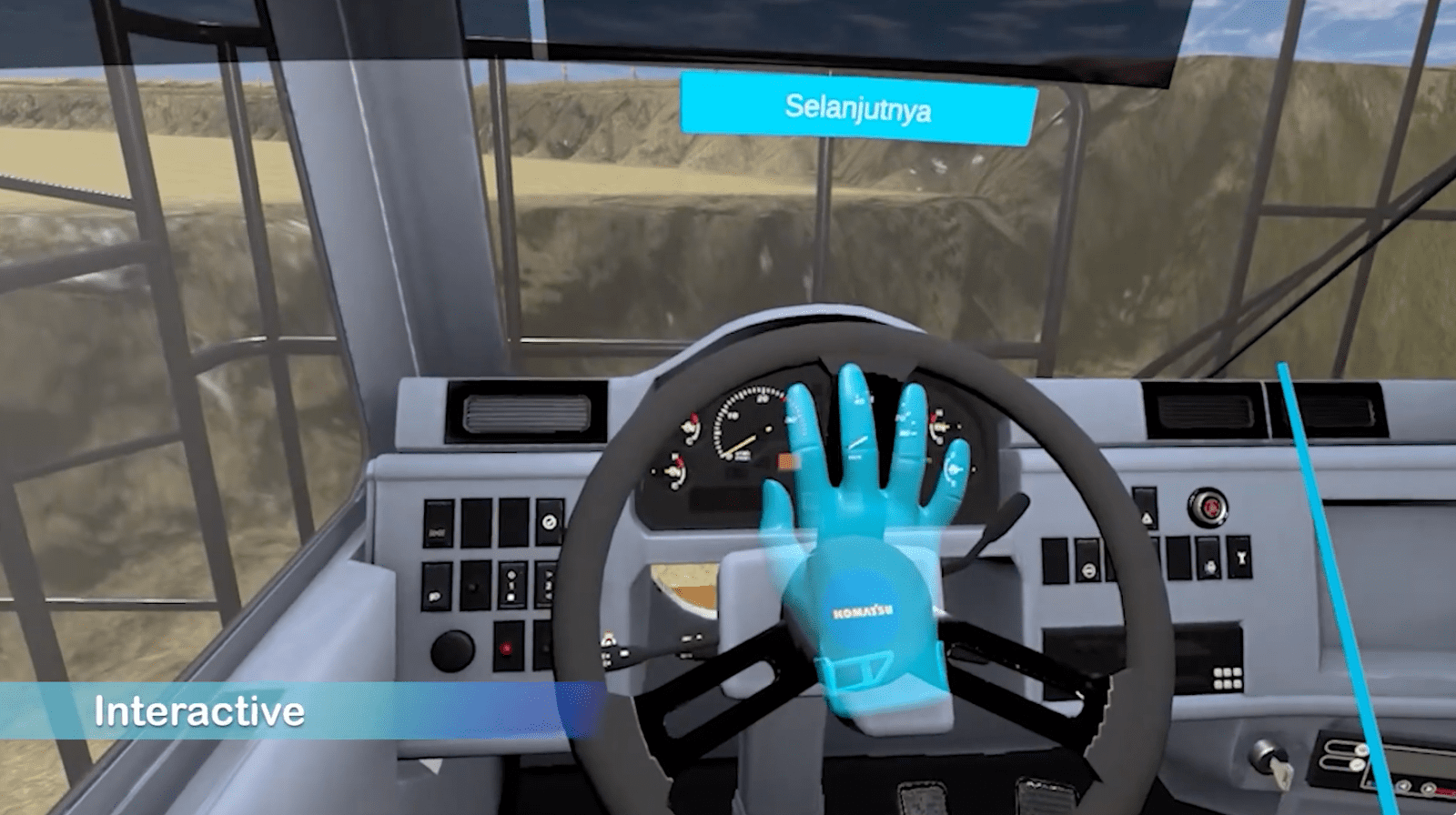
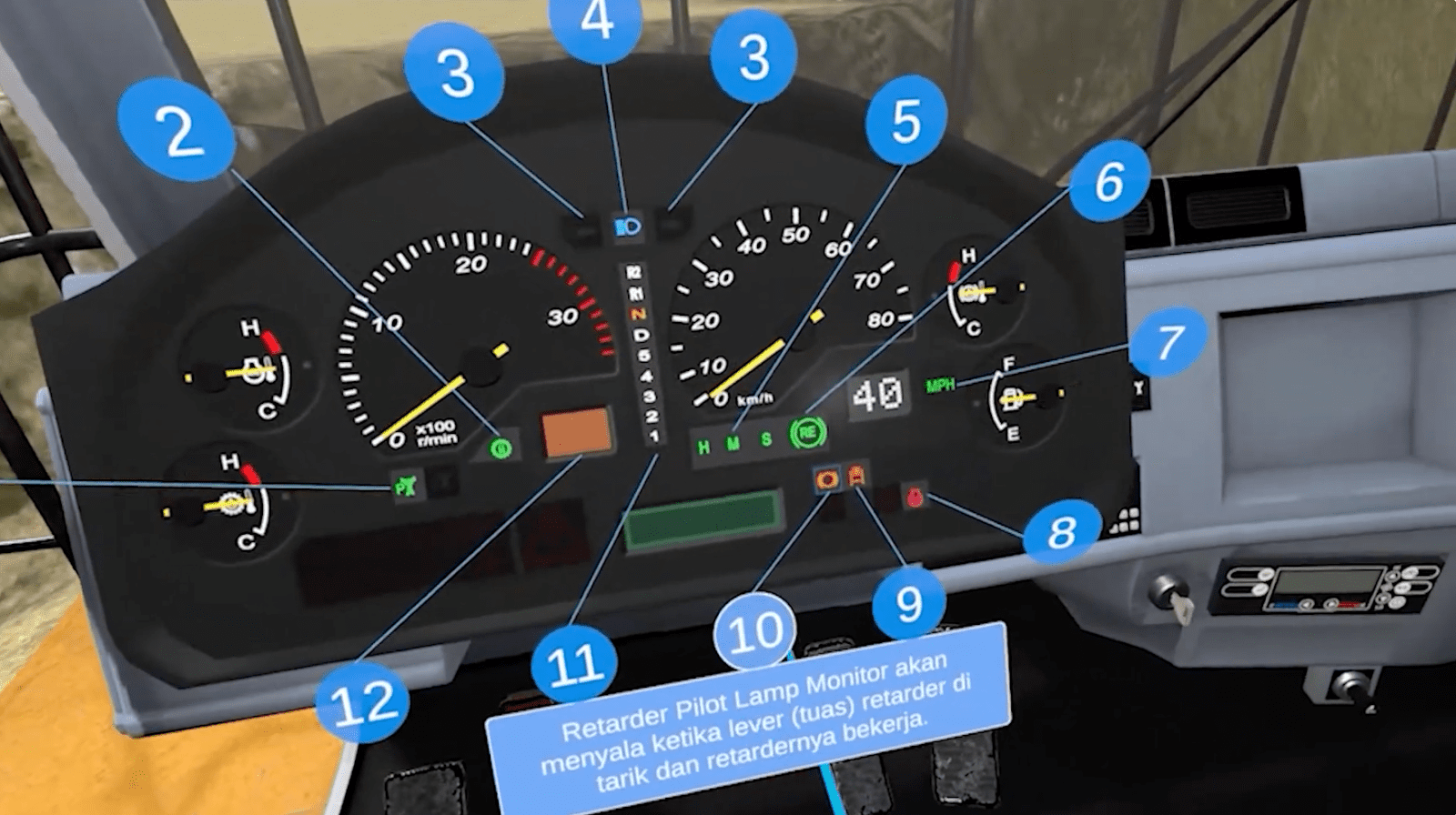
The third layer puts them in the cab. Every button, every lever, every gauge, every display — all mapped faithfully to the actual cabin layout. Trainees learn the startup sequence, which on heavy mining vehicles can involve a dozen steps that need to happen in the right order. They practice shutdown procedures. They familiarize themselves with the communication systems, the safety interlocks, the emergency stop mechanisms. All of this happens before they’ve set foot near an actual piece of equipment.
The fourth and final layer is simulation. Trainees operate the virtual vehicle through common work scenarios — loading, hauling, dumping, navigating pit roads, responding to unexpected situations. Their performance is tracked at a granular level: reaction times, gear selections, speed management on gradients, approach angles, braking patterns. All of this data feeds into a backend dashboard where supervisors can assess progress, identify weak points, and tailor follow-up training to each individual operator’s needs.
The 80% That Matters Most
When people talk about VR reducing training risk by 80%, it’s easy to dismiss as a marketing number. But consider what it actually represents in the context of mining operations.
Every hour a trainee spends on a real piece of equipment during the learning phase is an hour of elevated risk. They’re slower to react. They’re more likely to misjudge distances. They’re unfamiliar with the controls. They fatigue faster because the cognitive load is so much higher when everything is new. And crucially, that real equipment is taken out of production for training purposes, which means the cost compounds — you’re paying for risk and lost output simultaneously.
VR flips that equation. The hours that carry the highest risk — those early, stumbling, unfamiliar hours — get absorbed by the simulation. By the time a trainee climbs into a real cab, they already know the layout intimately. Their hands reach for the right lever instinctively. The startup sequence is muscle memory. The gauges make sense without having to think about them. They’ve already experienced common hazard scenarios and practiced the correct response.
The risk doesn’t disappear entirely — nothing can replace actual field experience — but the most dangerous portion of the learning curve gets compressed and contained inside a controlled virtual environment. That’s the 80%. Not a hypothetical projection, but a measurable shift in where exposure to risk occurs during the training lifecycle.
For BUMA, operating across multiple mine sites with clients like Adaro, Berau Coal, and Kideco, the scalability factor is equally critical. Traditional on-equipment training is inherently constrained by geography, equipment availability, and mentor capacity. VR training can be deployed at any site, run simultaneously for multiple trainees, and deliver a consistent standard regardless of which location or which shift a trainee belongs to.
What Supervisors Actually See
One of Virtu’s design priorities for the BUMA platform was making the training data actionable for supervisors — not just raw scores, but meaningful insights that inform real decisions about operator readiness.
The backend dashboard captures everything. Not just whether a trainee completed a module, but how they completed it. Did they follow the correct pre-operation inspection sequence, or did they skip steps? Did they check mirrors before reversing, or did they rely on habit? How did they handle the simulated scenario where a light vehicle unexpectedly entered their blind spot?
This granular tracking creates something that traditional training could never provide: an objective, data-driven profile of each operator’s competencies and gaps. Supervisors can see exactly where an individual needs additional practice before they’re cleared for field operations. They can identify patterns across cohorts — if multiple trainees consistently struggle with the same procedure, it signals a gap in the training material itself, not just individual performance.
For a company the size of BUMA, with thousands of operators spread across remote mine sites in Kalimantan, this level of visibility fundamentally changes how workforce readiness is managed. It shifts the conversation from subjective assessments and sign-off checklists to measurable competency benchmarks backed by behavioral data.
Why This Partnership Works
BUMA didn’t choose Virtu because they were the flashiest tech vendor in the room. They chose them because Virtu understood that mining VR training is not an entertainment product. It’s an operational tool that needs to integrate into existing workflows, meet specific safety compliance requirements, and deliver measurable outcomes that justify the investment.
Virtu’s track record in Indonesian heavy industry — spanning mining, aviation, military, and healthcare — gave them the domain knowledge to design a system that mining professionals would actually trust and use. Their development process involved studying actual equipment models, replicating real site conditions, and iterating based on feedback from experienced BUMA operators who knew exactly what felt right and what felt fake.
The result is a training ecosystem that BUMA treats not as a one-time project but as an ongoing partnership. The VR training portal — accessible at buma.virtu.co.id — covers operations, mechanics, and safety training, with mobile VR versions that allow operators to study equipment in 3D even without a headset. As BUMA’s fleet evolves and new equipment enters service, the VR training modules evolve alongside it.
This kind of long-term integration is what separates a meaningful VR training implementation from a flashy demo that collects dust after the first quarter. It requires a technology partner that thinks in operational cycles, not project milestones. And it requires a mining company willing to fundamentally rethink how it develops its workforce.
BUMA and Virtu found that alignment. The 80% safety improvement is simply what happens when you put the right problem in front of the right people and let them build the right solution.
What Comes Next
For mining companies watching this space — particularly those operating in Southeast Asia’s competitive coal and mineral sectors — the BUMA-Virtu collaboration offers a clear blueprint. VR training is no longer experimental. It’s no longer a luxury reserved for the largest multinationals. It’s a practical, deployable, and measurable tool that solves a problem every mining operation faces: how do you get operators field-ready faster, safer, and more consistently?
The answer, as BUMA’s experience demonstrates, is to let them fail safely first. Let them learn the hard lessons inside a headset before they learn them inside a cab. Let the simulation absorb the risk so the mine site doesn’t have to.
If your operation is still relying solely on manuals and ride-alongs to prepare new operators for heavy equipment, the gap between what they know and what they can do under pressure is probably wider than you think.
Explore how Virtu builds custom VR training for mining operations at virtu.co.id.
Contact Us
Call / WhatsApp: +62 812 9696 7887
Email: [email protected]
Website: www.virtu.co.id