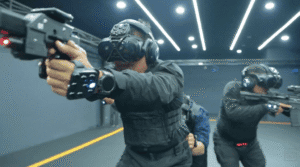


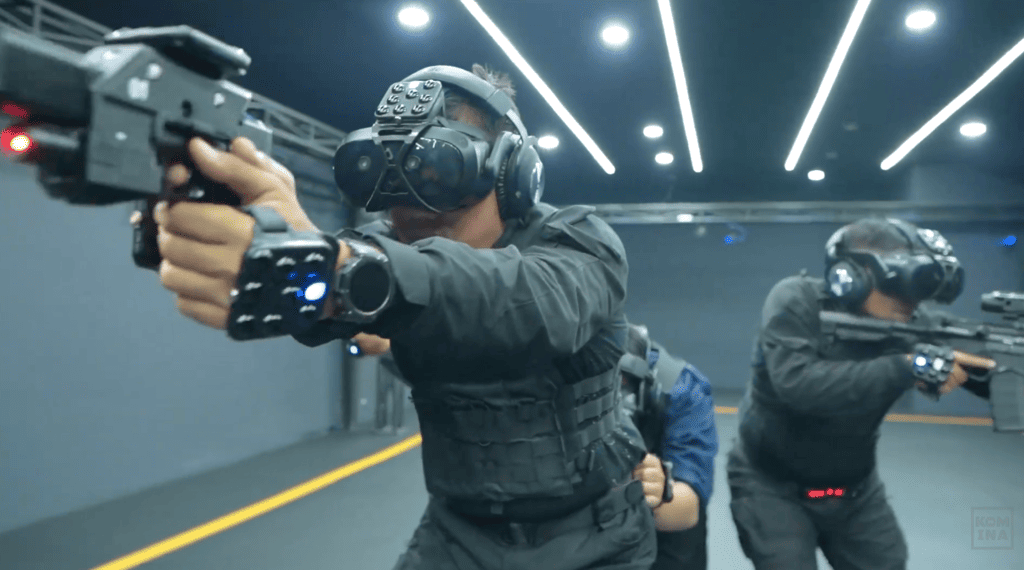
Target discrimination is the ability to distinguish between a person who poses a threat and a person who does not, and to respond accordingly. It is a core skill for both military and law enforcement personnel, because many operational environments contain civilians as well as potential threats.
This article explains how KOMINA, the virtual training platform developed by Komando Imersif Indonesia, supports target discrimination training through its civilian AI agents and related features.
Why Civilians Matter in Training
Some training formats contain only targets. On a standard firing range, for example, every target is intended to be engaged. This format is useful for developing marksmanship, but it does not require the trainee to decide whether to engage.
Operational environments are different. A building may contain residents, a public area may contain bystanders, and a hostage situation places non-combatants close to the threat. Training that includes civilians requires trainees to assess each person before acting.
Civilian Agents in KOMINA
KOMINA’s scenario system includes three types of spawnable AI agents: hostiles, civilians and law enforcement units. KOMINA describes civilians as non-combatants with panic responses and escape behaviours. Each civilian can be assigned one of three behaviours:
- Panicked
- Compliant
- Unpredictable
Assigning different behaviours to different civilians creates scenarios in which non-combatants do not all respond in the same way. The unpredictable behaviour is relevant to target discrimination, because a person whose actions are unclear requires careful assessment.
Hostile agents can be placed in the same scenario. KOMINA describes them as armed threats with varying skill levels and tactical awareness, with aggressive, defensive or ambush behaviour.
Scenarios That Include Civilians
Several of KOMINA’s pre-built scenarios involve non-combatants:
- Building Clearance: room-by-room clearing with unknown threats and civilians (medium difficulty)
- Hostage Response: critical incident management with negotiation and tactical entry options (very high difficulty)
- Drug Raid Operations: high-risk entry in residential and commercial buildings (high difficulty)
- Crowd Control: mass gathering management with escalation and de-escalation tactics (medium difficulty)
Instructors can also place civilians in custom environments built with the map editor, using the NPC spawner to set their position and behaviour.
KOMINA’s Situational Awareness use case, described as environmental scanning exercises that enhance threat detection and response, is closely related to target discrimination.
Varying the Scenario
KOMINA’s sandbox environment allows instructors to modify scenarios in real time, including threat levels and NPC behaviour. Changing the position and behaviour of civilians and hostiles between runs prevents trainees from relying on memory of a previous run.
Measuring Discrimination Errors
Target discrimination errors can occur in two ways: engaging a person who is not a threat, or delaying a response to a person who is. Both can be reviewed in KOMINA’s after-action review. Each type of error has a different cause and usually needs a different form of corrective training.
Metrics listed by KOMINA include threat identification time, decision-making speed, reaction time and shot accuracy. The 3D replay can be viewed from any angle to see what each agent was doing at the time of a decision.
The cone view shows a trainee’s perspective and field of view. This helps instructors determine if a trainee did not see a relevant detail or saw it and misjudged it, which may require different corrective training.
Progress tracking stores results across sessions, so units can review changes in identification time and error rates over a training period.
Training Under Pressure
KOMINA uses electric shockbelt haptics to provide physical hit confirmation, with adjustable intensity. Heart rate monitoring and stress tracking are available to instructors. These features allow instructors to compare stress levels with decisions made during the scenario.
Relevance for Military and Law Enforcement
For law enforcement, target discrimination is connected to the lawful and proportional use of force. For military personnel, it is connected to rules of engagement in environments where civilians are present.
Limits
AI civilian agents follow configured behaviours and do not fully reproduce the range of human behaviour. Training with live role-players remains useful. KOMINA states that virtual training complements traditional training rather than replacing it.
KOMINA’s civilian agents allow target discrimination to be practised repeatedly in varied scenarios with consistent measurement. Organisations can contact KOMINA to see how civilian agents are configured.